

Your great business idea may not be enough!
You may have been losing sleep over a business idea you cannot wait to launch. Maybe you’ve spent weeks refining the product, perfecting the branding, building the website, working on your marketing, and polishing a pitch that you believe will get people interested.
These things matter. But there is something underneath all of them that could determine whether your idea becomes a business that survives or one that struggles despite having a great product: YOUR BUSINESS MODEL.
Over the past seven weeks in Rome Business School’s pre-incubation program, I had the opportunity to learn from professionals who work with businesses across different industries and markets. One session, led by Dr. Johnmark Nzemeke, made me look beyond the product itself and examine how a business creates value, gets that value to the right customer, makes money from it, and builds a system that can survive and grow.
In this guide, I’ll break down what I learned and help you apply it to your own idea or existing business. By the end, you’ll have a practical framework for examining, designing, and strengthening your business model, with a downloadable assessment you can use to identify where your model is strong, where it is vulnerable, and what you need to work on next.
The Lesson That Changed How I Think About Business Ideas
Put your business idea on the table for a moment. Forget the logo, website, marketing, and pitch. I want you to look at what sits underneath all of that.
Can this idea survive, scale, and create value repeatedly?
That last word matters.
Making a sale is one thing. Building a business that can keep solving a problem, serving customers, making money, and growing without everything depending on you is another.
This was one of my biggest takeaways from the pre-incubation program. It shifted my attention from “Is this a great idea?” to something more important: “Is there a strong business within this idea?”
One way to find out is to examine it through four lenses:
Is your business designed, built, defended, and fundable?
In simple terms, does the model work, can it grow, can competitors easily copy it, and do the numbers make sense?
Now, I want you to keep your business idea in mind as we go through this piece together.
We’re about to start pulling that model apart, beginning with the opportunity you’re trying to build around.
A Big Problem Is Not Automatically a Business Opportunity
Start with the problem your business is trying to solve.
If you’re building in Nigeria or elsewhere in Africa, you probably don’t have to look far to find one big business opportunity. Think power, logistics, healthcare, education, housing, food, payments, and water. For an entrepreneur, these problems can also represent markets waiting for better solutions.
Nigeria alone has more than 200 million people and a predominantly young population. That is more than a population statistic. It represents millions of people buying, working, learning, paying, and looking for better ways to meet everyday needs.

But there is an important distinction: seeing a problem and having a viable business opportunity are not the same thing.
A problem becomes a business opportunity when you can solve it in a way people value, trust, pay for, and return to.
And your environment matters.
In West Africa, your model may need to account for the following:
- Infrastructure gaps,
- Expensive capital,
- Inflation,
- Currency fluctuations,
- Supply challenges, and
- Last-mile distribution.
At the same time, digital payments, mobile adoption, and technology are creating new ways to reach customers.
This is why resilience cannot be a backup plan. It has to be part of your business model, especially in Africa.
A model that works elsewhere may not work the same way here. Your pricing, distribution, costs, partnerships, and even how you build trust may need to change.
That’s why a big market does not guarantee demand for your solution. A real problem does not guarantee people will pay you to solve it. And a great product does not guarantee you can deliver it profitably and repeatedly.
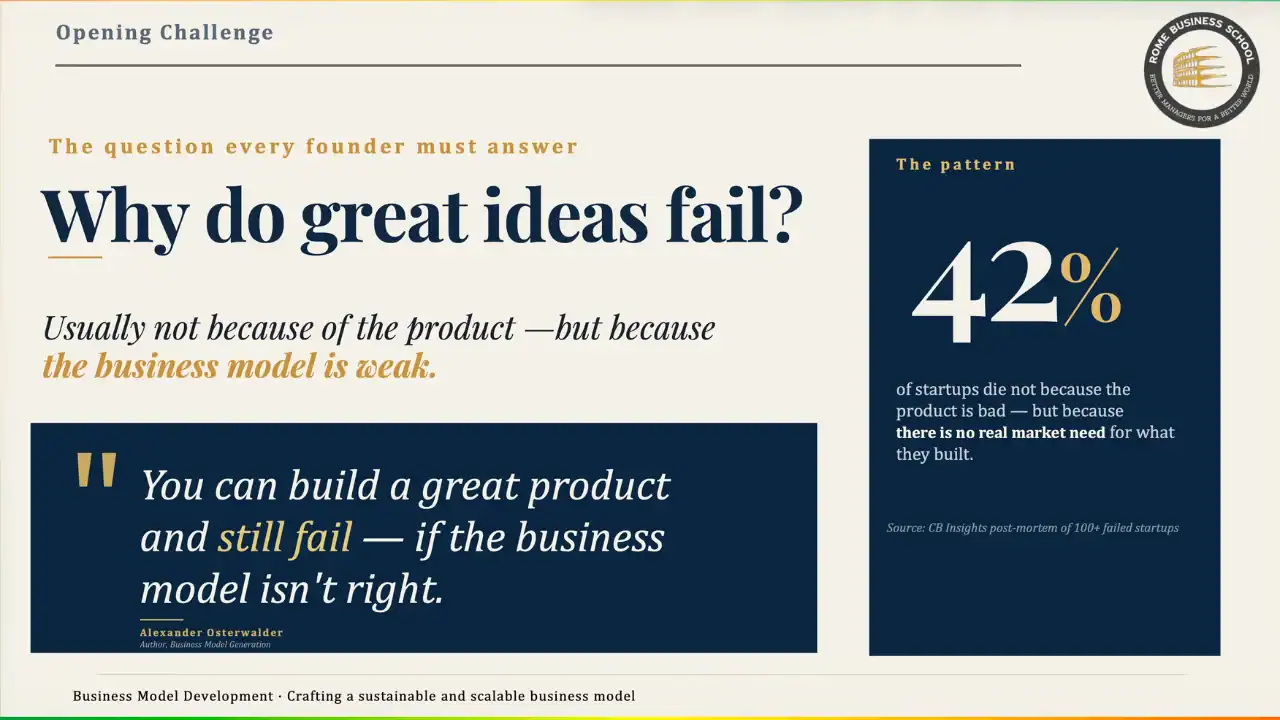
That’s why it’s critical to pay utmost attention to the business model you’re running with.
So, what exactly is a business model?
What a Business Model Really Is?
Now that we’ve separated a problem from a viable business opportunity, let’s look at the model that turns one into the other.
A business model is simply the story of how your business creates, delivers, and captures value.
Think of it as three connected parts that:
- Create value: What problem are you solving, and for whom? Your value needs to matter to a specific customer, not everyone.
- Deliver value: How does that solution get into your customer’s hands? It could be through a physical store, website, app, sales team, distributor, marketplace, or another channel that makes sense for them.
- Capture value: How does money come back into the business? What will customers pay, how often will they pay, and how much will you keep after serving them?
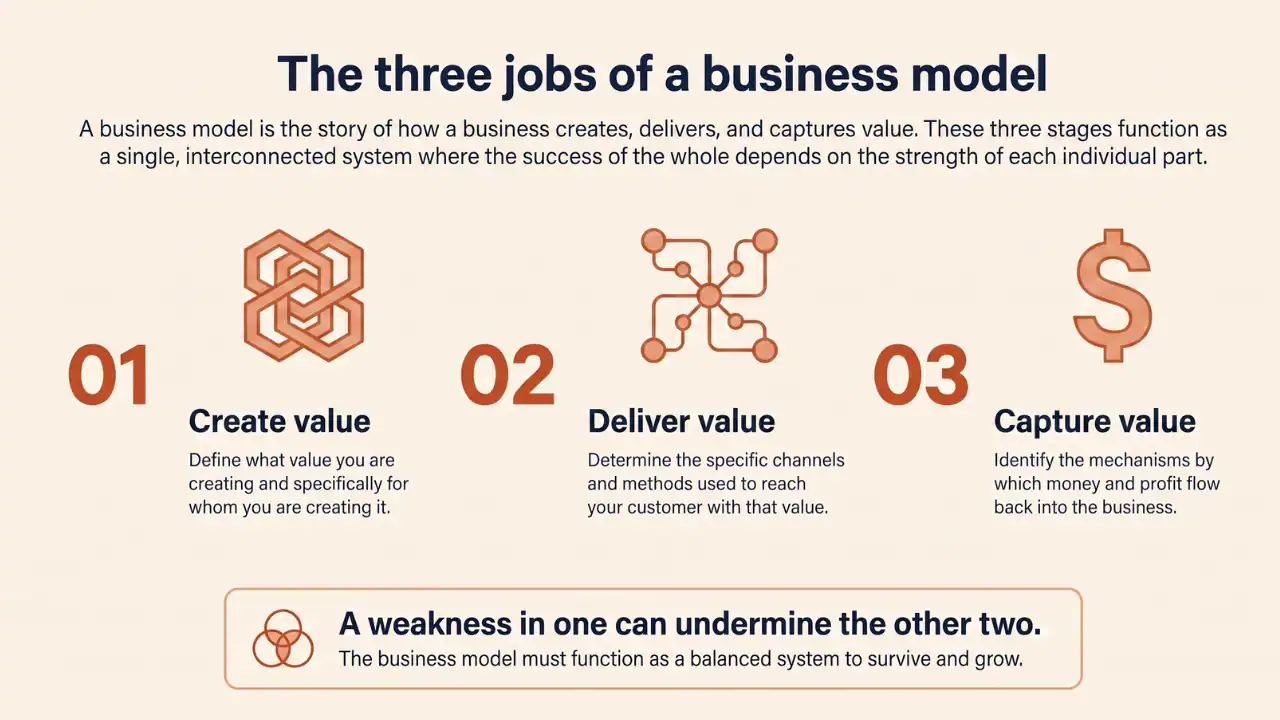
Here’s where these three become useful: they depend on each other.
- You can create something customers genuinely value but struggle to reach them.
- You can deliver an excellent experience but charge too little to sustain it.
- You can make money initially but lose customers because they do not receive enough value to return.
This is why I quickly fell in love with the concept of business model development. A good business model forces you to look at the whole system rather than the product alone.
So, let’s go back to the business idea we’ve had on the table since the beginning and identify one thing:
Which is weakest right now in yur idea: creating value, delivering value, or capturing value?
Keep your answer. In the next section, we’ll put all the three on one page and see how the rest of your business fits around them.
Let’s go
How to Design Your Business Model on One Page
You’ve identified how your business creates, delivers, and captures value. Now we need to see whether all those pieces actually work together.
This is where the Business Model Canvas (BMC) becomes useful.
Think of it less as a template to complete and more as a strategic map of your business. See it as a tool in the hand of an architect. Yes, you’ll be designing your business in a few minutes.
With the BMC, in nine blocks, you should be able to explain how the entire business works without hiding behind jargon.
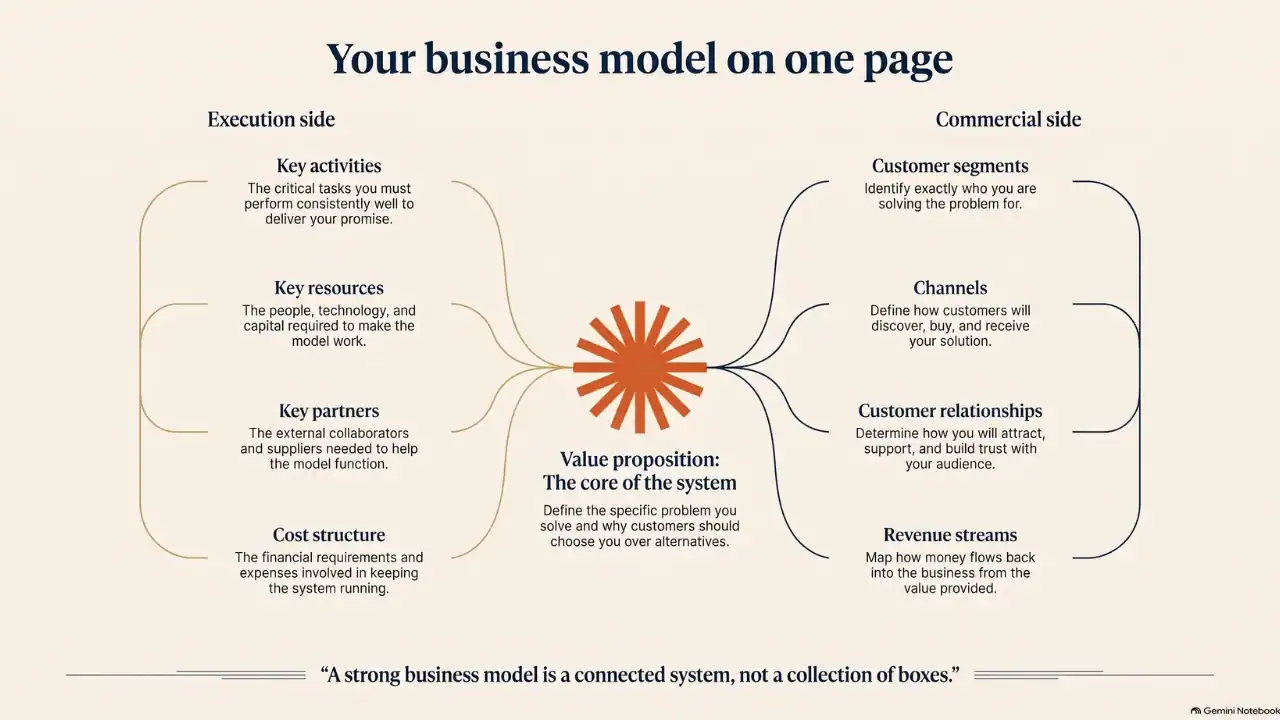
To make the nine blocks easier to work through, I like to think about them in two parts.
The operating side: how the business creates and captures value
- Value proposition: What problem are you solving, and why should customers choose you?
- Customer segments: Who exactly are you solving it for?
- Channels: How will those customers discover, buy, and receive your solution?
- Customer relationships: How will you attract, support, retain, and build trust with them?
- Revenue streams: How will the business make money?
The building side: what makes delivery possible
- Key activities: What must you consistently do well to deliver your promise?
- Key resources: What people, technology, capital, assets, or knowledge do you need?
- Key partners: Who do you need to help the model work?
- Cost structure: What will it cost to keep everything running?
But filling the nine boxes is not the goal. The real value comes from seeing whether your answers fit together.
Imagine positioning yourself as a premium brand while delivering an unreliable customer experience. Or promising highly customised services while expecting extremely low delivery costs. Even targeting “everyone” creates a problem because it becomes difficult to build a message or channel around a customer you cannot clearly define.
One decision affects another.
See how this works in practice
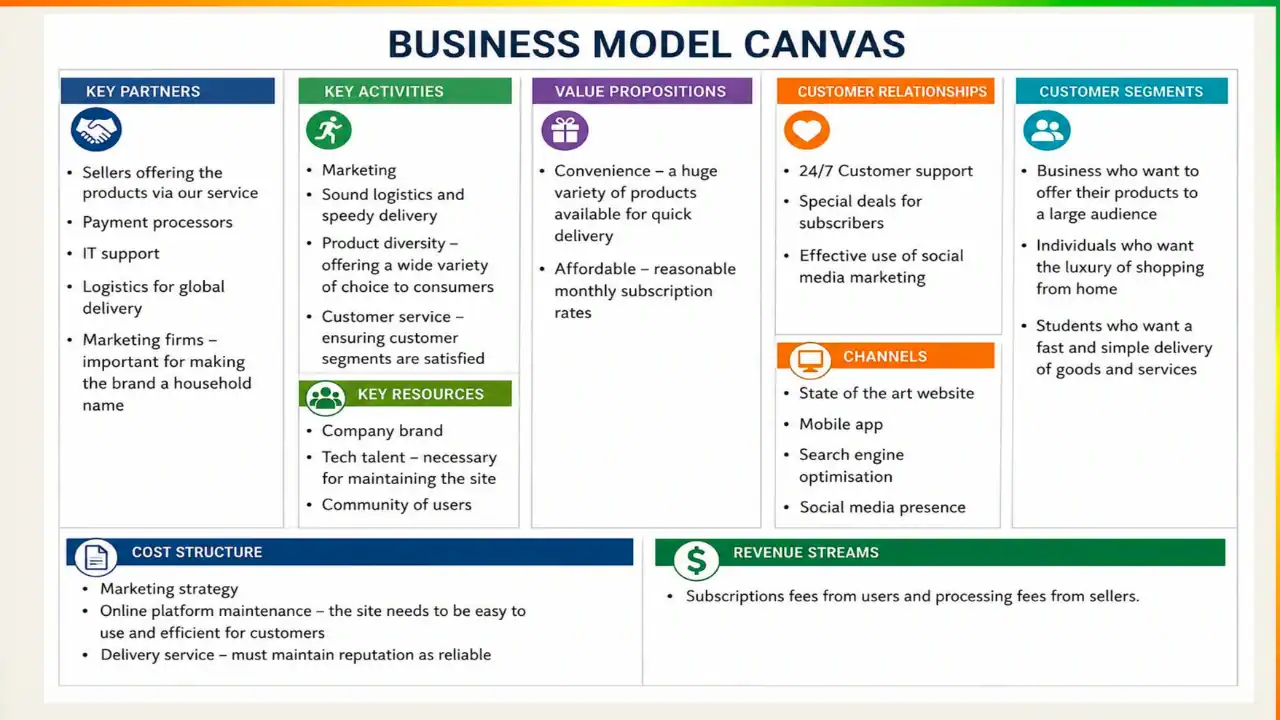
Take a simple e-commerce business built around convenience and affordability. If that is the value proposition, the rest of the canvas has to support it.
The business needs channels that make shopping convenient, reliable payment and logistics partners, enough product variety, and a cost structure that still allows it to keep prices competitive. Its revenue could then combine seller subscriptions with transaction fees.
You can see the same thinking with Starbucks. The product may be coffee, but the value proposition goes beyond the drink to the coffee experience. That influences its stores, customer relationships, loyalty programs, distribution, resources, partnerships, and revenue streams.
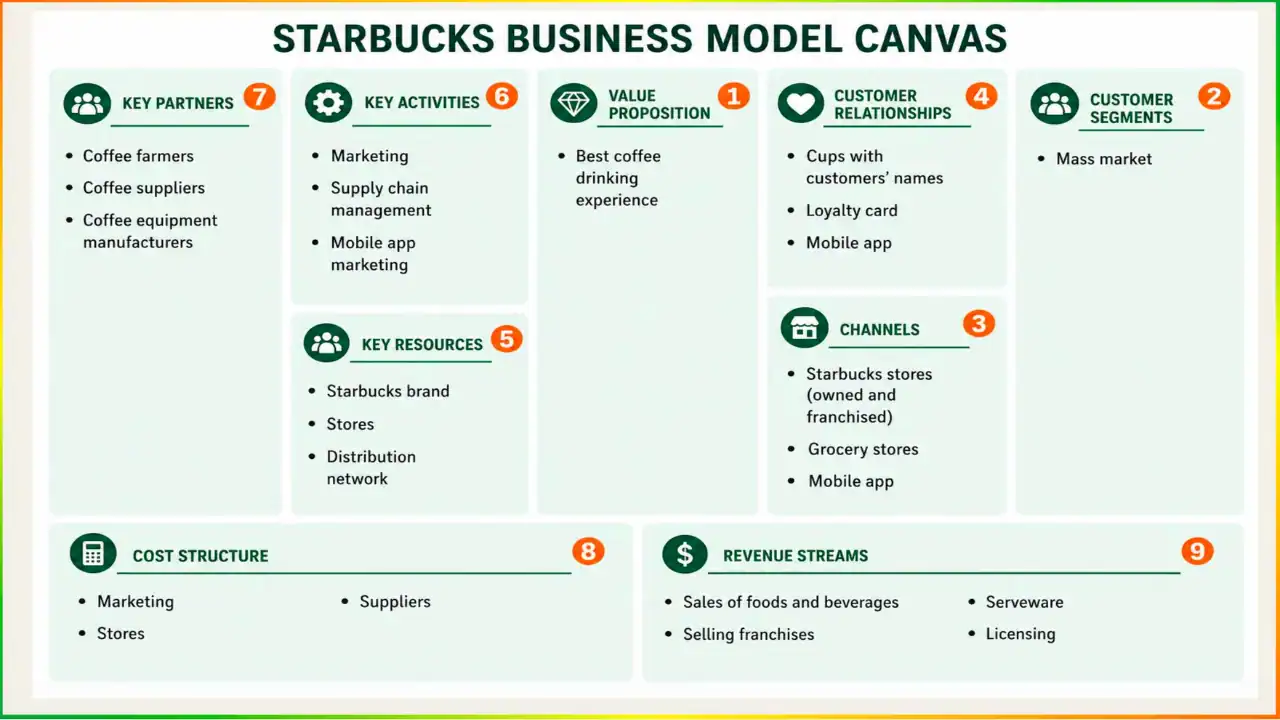
That’s the power of seeing your business on one page. You stop making decisions about marketing, pricing, operations, customers, and costs in isolation. You can see how changing one part affects the others.
And if you’re looking at those nine boxes thinking, I’m not even clear about my value proposition yet, that’s where we need to go next.
How to Build a Value Proposition People Actually Care About
If the value proposition box on your canvas feels difficult to complete, don’t force it. You may need to validate the idea before designing the rest of the business around it.
This is especially important if you’re still at the idea stage.
Start with a Lean Canvas. Use it to test the basics: the problem you believe exists, the solution you want to offer, the customers who experience that problem, and what could make your approach different. Once you have stronger evidence that the problem is worth solving, you can use the Business Model Canvas to design how the business will operate around it.

Think of the decision this way:
Still testing the problem and solution → Lean Canvas
Ready to design how the business works → Business Model Canvas
Either way, you eventually arrive at the same important question: why should someone choose you?
Your value proposition needs to give them a compelling answer. I like the three tests from the session because they make this easier to examine.
1. Solve a painful problem
Start with the problem, not the features of your product.
Consider what happens when your solution does not exist. Does the customer lose money, waste time, take unnecessary risks, struggle with an inefficient process, or immediately look for another solution?
The stronger the problem, the more meaningful your solution can become.
2. Create a measurable gain
Now look at what changes because your solution exists.
Does something become faster, cheaper, easier, safer, more profitable, or more reliable?
Be specific. For example, “We help businesses save time” is weak. Showing exactly where you remove hours from a process gives the customer something they can understand and value. “We automate manual inventory updates so small retailers spend less time tracking stock each week.” The more clearly you can show what becomes faster, cheaper, easier, safer, or more reliable, the easier it is for customers to understand your value.
3. Give customers a reason to choose you
Solving a real problem is not enough if several alternatives already solve it equally well.
Your customer needs a reason to choose your solution instead. That difference could come from price, convenience, speed, expertise, accessibility, experience, technology, distribution, or something else your market genuinely values.
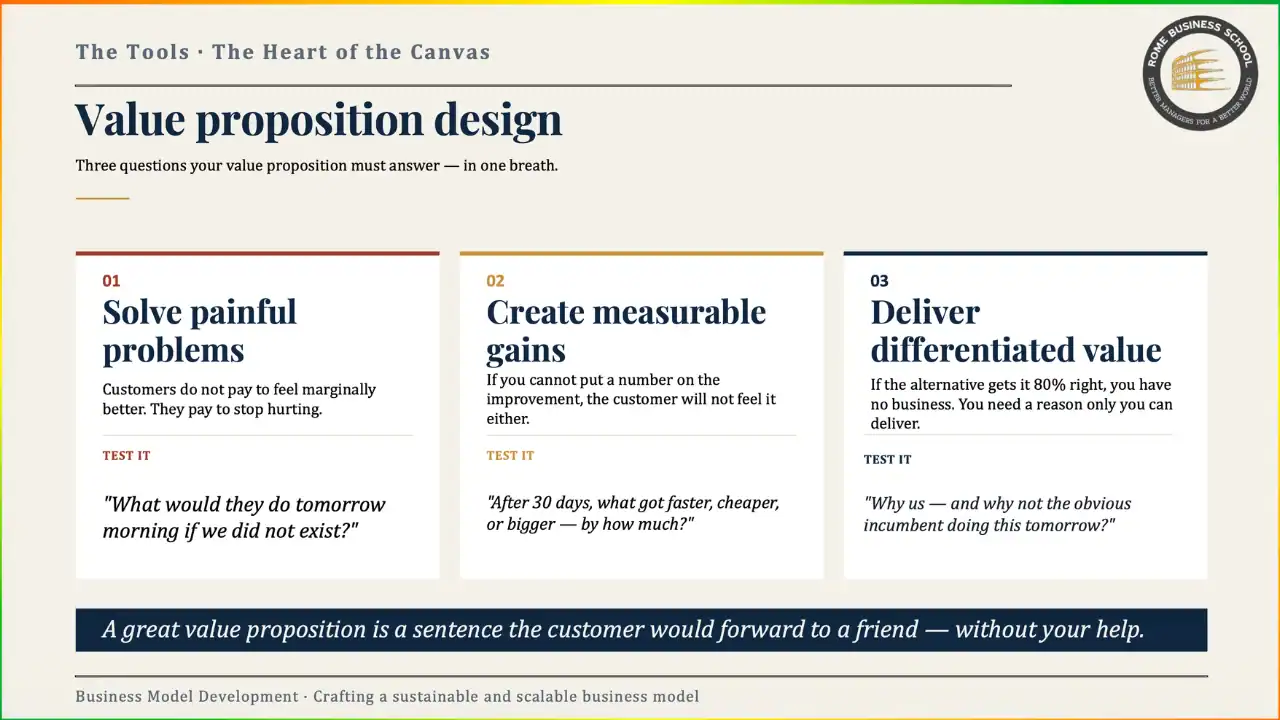
Here’s a simple test for everything you’ve written about your value proposition:
Could your customer explain your value to a friend in one sentence without your help?
If they need your pitch deck to explain why your business matters, the value proposition probably needs more work.
And even when your value is clear, there is another question worth asking: how urgently does your customer need it?
That brings us to the aspirin vs. vitamin test.
The Aspirin vs. Vitamin Test
You now have a clearer idea of the value you want to offer. But there’s another layer to examine:
How urgently does your customer need it?
One way to think about this is the aspirin vs. vitamin test.
A vitamin solves a problem or creates an improvement, but the customer can often postpone buying it. An aspirin addresses something more immediate. The customer feels enough pain, inconvenience, cost, or risk to want a solution sooner.
Neither automatically makes a good or bad business. But when you’re building an early-stage venture with limited time and resources, solving an urgent problem can make it easier to get customers to act.
Here’s the example we used from the session.
Imagine you notice that people struggle with washing dishes and decide to solve the problem. One option is to build and sell dishwashers. Useful? Absolutely. But many customers can postpone buying one.
Now imagine offering an effective dishwashing liquid instead. People who wash dishes need a cleaning product regularly, making the purchase much harder to postpone.
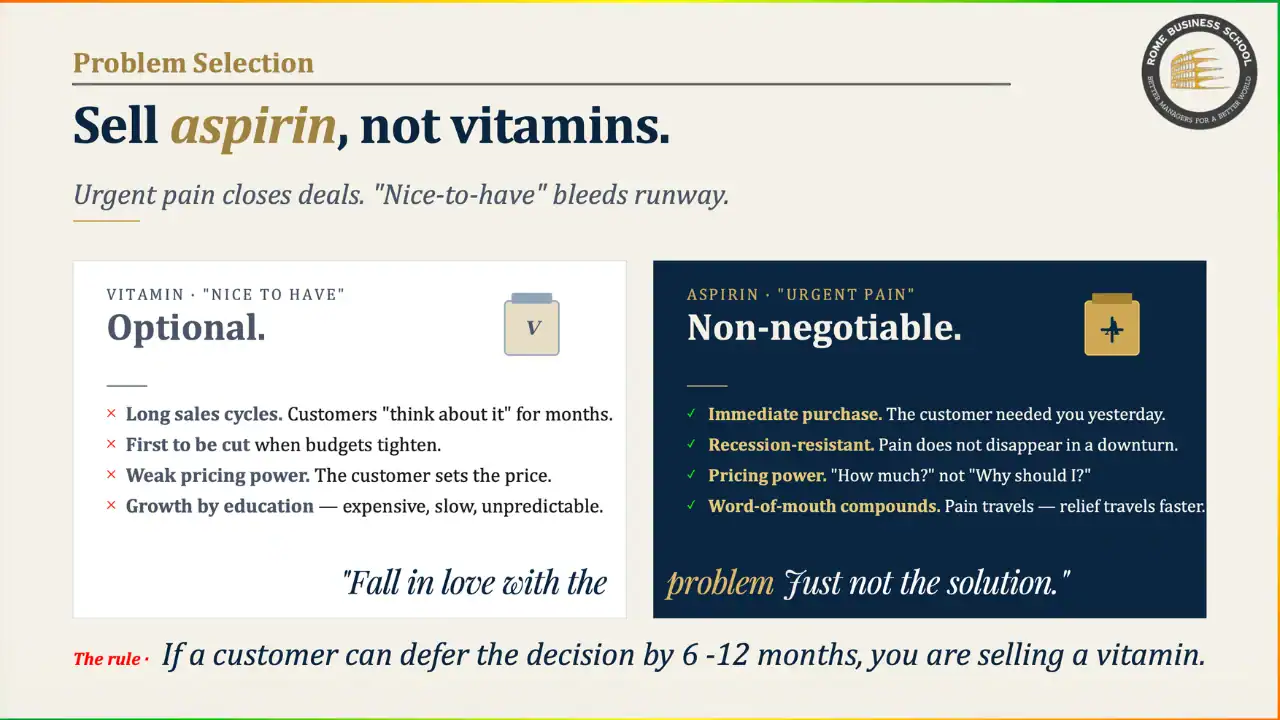
Urgency affects more than whether someone likes your idea. It can influence how quickly customers make buying decisions, how much convincing they need, and how willing they are to pay for relief.
So, look at the problem your business solves and classify it:
Urgent pain, nice-to-have improvement, or somewhere in between?
If customers can comfortably postpone solving it for months, you may need to strengthen the value proposition or reconsider which part of the problem you solve first.
That last part matters because you don’t have to abandon the problem when your first solution feels like a vitamin. Sometimes you need a better entry point.
And that brings us to another principle that can make an early business easier to build: start focused.
BTW, I built a tool you can brainstorm with if you’re struggling to figure out whether your business is solving an aspirin or vitamin problem. It can also help you get clearer on your positioning.
Why Simplicity Gives Early Businesses an Advantage
Once you know the problem is worth solving, the temptation is to solve it for as many people as possible.
Resist that temptation, especially at the beginning.
A simple formula from the session captures this well:
One market × one problem × one offering
This does not mean thinking small. It means deciding where you want to win first.
Think about the difference between saying, “We help African businesses with digital solutions” and “We help Nigerian online merchants accept payments.” The second gives you a clearer customer, problem, offering, message, and starting point.
Some of the businesses we know today started with that kind of focus. Amazon began by selling books online before expanding into other categories. Facebook initially served Harvard students before reaching other universities and eventually the wider public. Paystack’s early focus centred on helping African businesses accept online payments.
The pattern is simple: start narrow, solve one problem well, learn from the market, then earn the right to expand.
Now bring your business back to the table and try completing this:
- One market: Who exactly am I serving?
- One problem: What specific problem am I solving?
- One offering: What am I giving them to solve it?
If you cannot describe your business clearly using those three pieces, narrowing your focus may be one of the most valuable things you can do before adding more products, features, or customer segments.
Because once you know where you want to win, the next challenge is making sure the business can survive there and grow from there.
Your Business Needs Two Engines: Sustainability and Scalability
You’ve narrowed your market, problem, and offering. Now we need to see whether the business you’re building can do two things at the same time: survive and grow.
That is the difference between sustainability and scalability.
Sustainability asks: Can this business survive? Are you earning enough from each customer to cover the cost of serving them? Can the business withstand slower months, rising costs, or unexpected changes without constantly running out of cash?
Scalability asks: Can this business grow efficiently? As you serve more customers, can revenue grow faster than costs, or will every new customer require the same increase in people, time, and money?
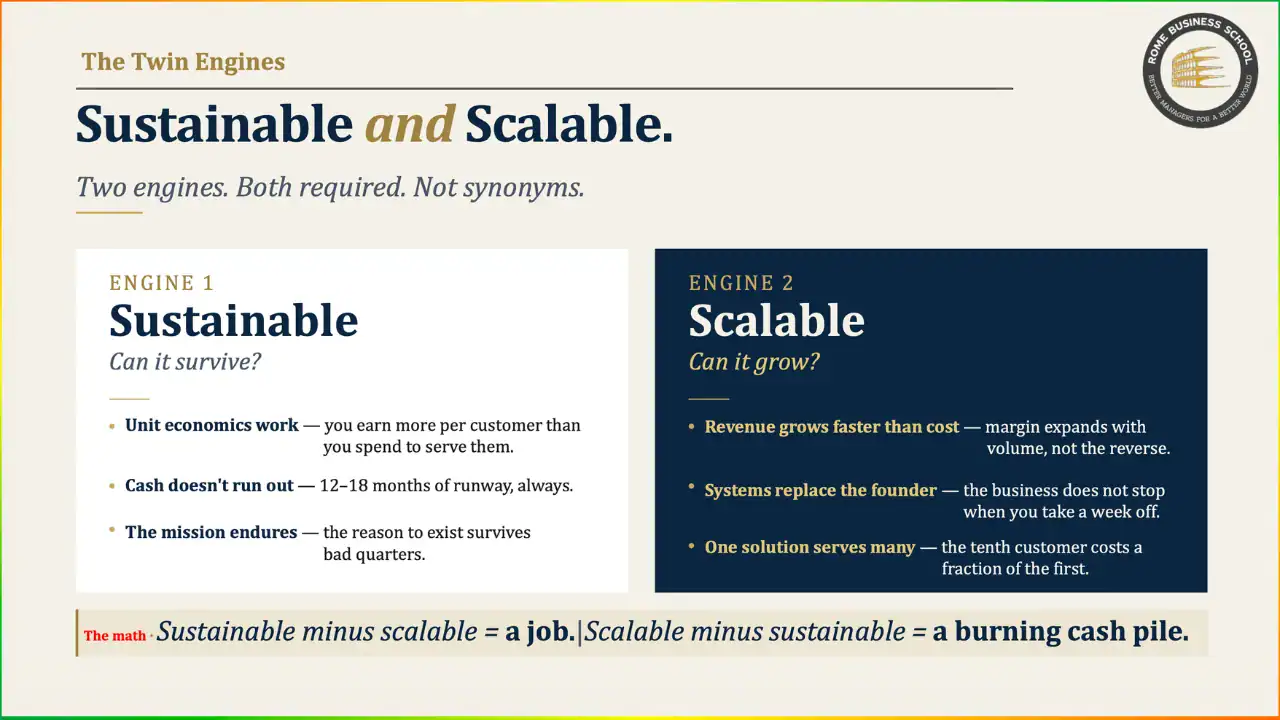
This is where founder dependence becomes a useful test.
If every sale needs you, every customer complaint comes to you, and every important decision waits for your approval, you may have created something sustainable, but scaling it will be difficult.
As Dr. Johnmark put it during the session, a sustainable business that cannot scale can become a job. A scalable business that cannot sustain itself can become a burning cash pile. You need both engines working together.
Now look at your business and decide:
Which engine is weaker today: sustainability or scalability?
If scalability is the answer, go one step further.
What Will Break First if Your Business Grows 10X?
Imagine waking up tomorrow to ten times your current demand.
It sounds like a good problem to have, until orders start piling up, customer service slows down, cash gets tight, and processes that worked for 20 customers begin falling apart at 200.
Growth does not fix weaknesses in your business. It exposes them.
The scalability framework gives you five places to look:
- People: Do you have a team that can make decisions and take ownership without everything coming back to you?
- Processes: Can the way you work today be documented and repeated as customer numbers grow?
- Technology: Can your systems handle more customers without requiring the same increase in manual work?
- Capital: Do you have enough cash, or access to the right funding, to finance growth before the returns arrive?
- Partnerships: What could the right suppliers, distributors, logistics providers, or technology partners help you scale without building everything yourself?
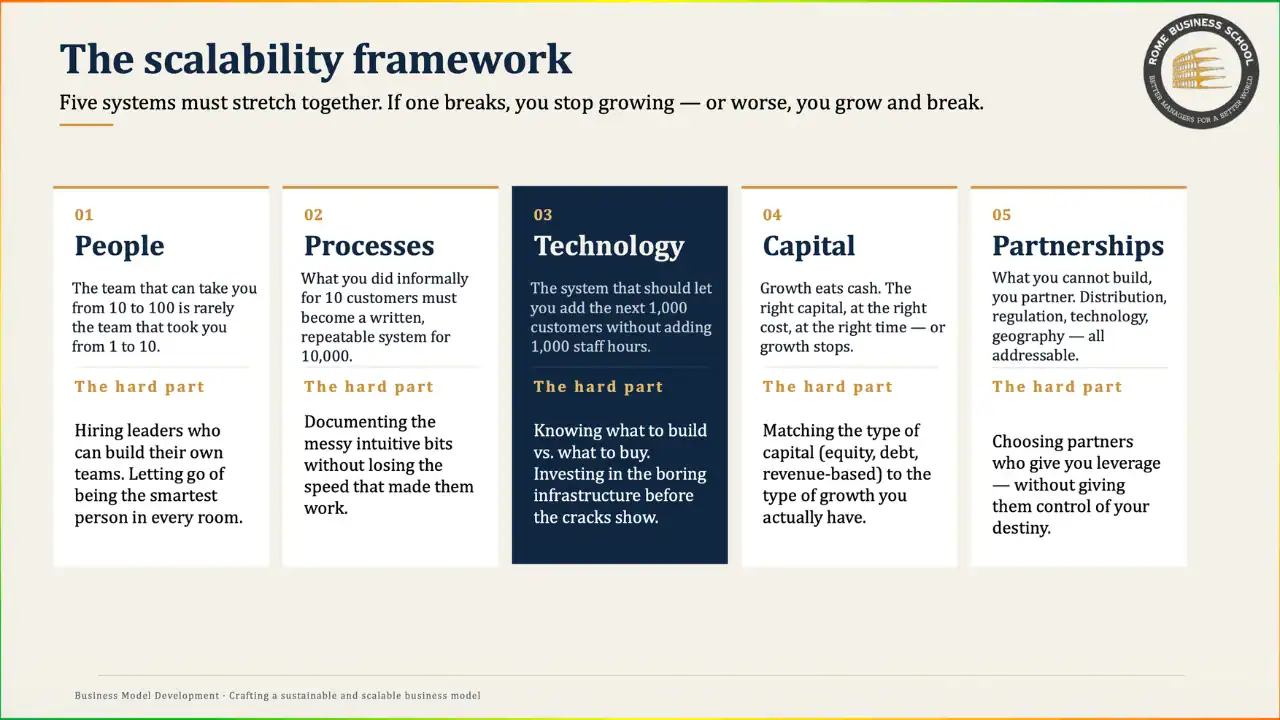
You don’t need all five to be perfect today. You do need to know which one is most likely to become your bottleneck.
Because sometimes the clearest way to see what needs fixing in a business model is to look for the warning signs already showing up.
Six Warning Signs Your Business Model Needs Attention
By now, you’ve examined the major pieces of your business model. So, let’s do a quick health check.
These six warning signs do not mean your business is doomed. Think of them as early signals showing you where the model may need redesigning before growth makes the problem more expensive.
1. You’re targeting everyone
If everyone is your customer, it becomes difficult to create a message, offer, price, or channel that speaks clearly to anyone. Go back to your one market, one problem, one offering.
2. You’re solving a nice-to-have problem
Remember the aspirin vs. vitamin test. If customers like your solution but can comfortably postpone buying it, you may have to work much harder to create demand.
3. Every customer gets a different offer
Customisation can win customers, but excessive customisation makes scaling difficult. If every sale requires a new proposal, process, or delivery method, you may be building more work rather than a repeatable business.
4. Referrals are your only source of growth
Referrals are valuable, but they are difficult to predict. A stronger model gives you repeatable ways to find customers instead of depending entirely on who recommends you next.
5. The business cannot function without you
If sales, approvals, delivery, customer service, and important decisions all depend on you, you have become the bottleneck. Growth will only make that dependence more visible.
6. You don’t know how the business becomes profitable
“We’ll figure out monetization later” is a risky foundation. You need to understand how revenue comes in, what it costs to serve customers, and what needs to happen for the business to make a profit.
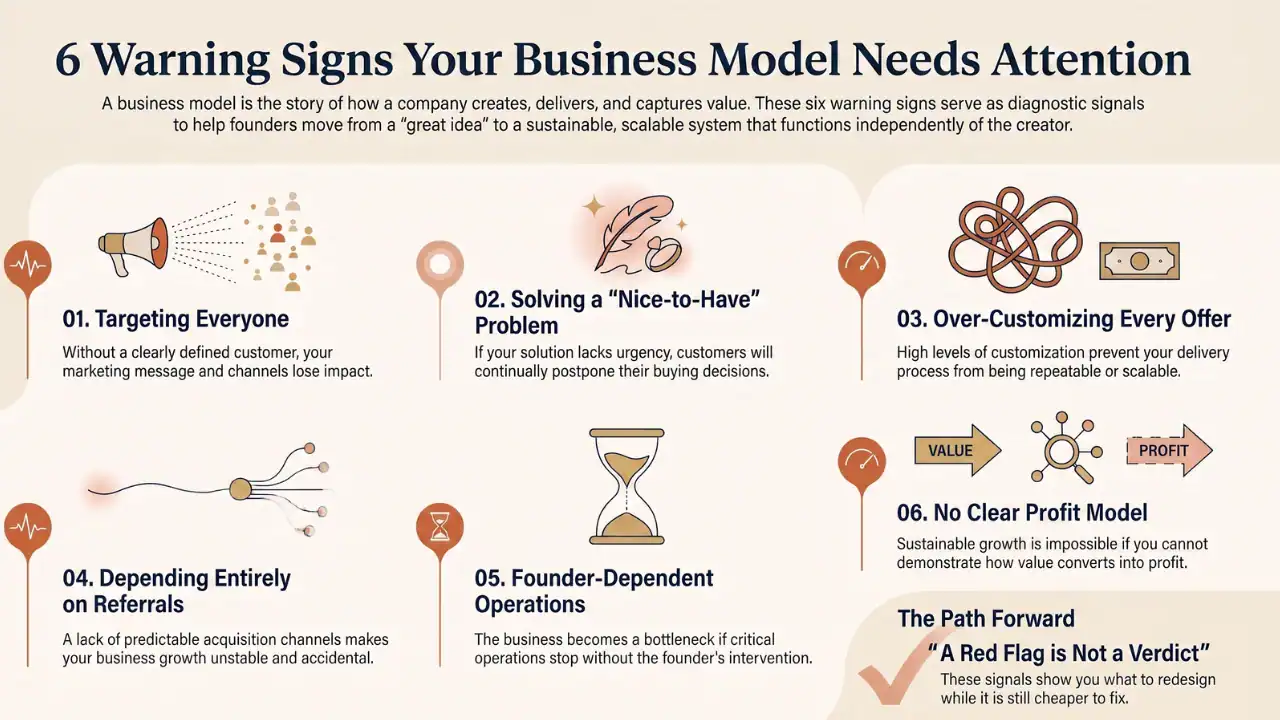
Now, don’t read this list and panic. Diagnose it.
Use these six warning signs to score your own business: give yourself 0 if a warning sign doesn’t describe your business, 1 if it is partly true, and 2 if it is definitely true.
Don’t worry about getting a perfect score. The purpose is to see where your business model needs attention while the problem is still cheaper and easier to fix.
I’ll include this diagnostic in the downloadable Business Model Assessment I created at the end of the page, so you can work through it alongside the other exercises in this guide.
A Seven-Day Business Model Challenge For You
If there is one thing I’m taking away from this experience, it is that a business model makes you look at your business as a whole, not as a collection of separate decisions.
Sitting with a Business Model Canvas forces you to connect things you might otherwise think about separately: your customers, marketing, branding, pricing, revenue, resources, operations, partnerships, costs, and the experience you want people to have with your business.
And that connection matters.
Change your customer, and your value proposition may need to change. Change your value proposition, and you may need different channels, activities, or resources. Change how you deliver, and your costs could change too.
Nothing on the canvas really stands alone.
That is what I now find so valuable about the exercise. It gives you somewhere to step back from the excitement of the product and see the business you are actually building.
Give yourself seven days
I don’t want you to finish this guide, close the page, and leave your business exactly where it was.
Go back to the idea we put on the table at the beginning and choose one thing you will change or test within the next seven days.
You might narrow your customer segment, rewrite your value proposition, test how urgently customers need your solution, calculate your gross margin, document a process that currently depends on you, or speak to real customers about an assumption you have been making.
Pick one, test it, and learn from what happens.
You do not need a perfect business model before you move forward. You need one that becomes stronger as you learn what works, what doesn’t, and what your customers actually need.
A great product still matters, but the business model determines whether you can create value, deliver it, capture enough value in return, and repeat that process as you grow.
Before you spend more money launching, hiring, marketing, or scaling, take your business through the Business Model Assessment below. Use it to identify what is working, what needs attention, and the next decision you need to make.
Then take that first action within seven days.
Frequently asked questions
What problem does my business really need to solve?
Start by narrowing your focus. A broad industry like entertainment, media, healthcare, or SMEs can contain dozens of different customer groups and problems.
Choose a specific customer first, then look closely at the problems they repeatedly face. You do not always need to participate directly in the industry to build a business around it. Sometimes the stronger opportunity is solving a problem for the people already operating there.
The key is to fall in love with the problem, not your first solution. When you stay focused on the problem, you can keep refining how you solve it as you learn more from the market.
How Do I Know Whether the Problem I Identified Is Real?
Treat your first idea about the problem as a hypothesis, not a fact.
Write down what you believe your customers struggle with, then test those assumptions with the people who actually experience the problem. You can use interviews, questionnaires, observations, customer conversations, surveys, or small market tests.
Pay attention to what people already do to solve the problem, what frustrates them about the current options, and what they are willing to pay to improve.
The goal is not to prove your original assumption right. It is to learn what the real problem is before investing heavily in the solution.
How Do I Know That My Target Market Too Broad?
If your target customer is described as “everyone,” “African SMEs,” “mothers,” or another very large group, you may need to narrow it.
A useful way to do that is to look at four things:
- Location: Where are you starting?
- Industry: Which specific sector are you serving?
- Stage: Are they startups, growing businesses, or established companies?
- Problem: What painful issue do they share?
For example, “branding for SMEs” is broad. “Brand strategy for early-stage fashion and beauty businesses in Nigeria” gives you a much clearer starting point.
You can expand later. First, give yourself somewhere specific to win.
How Should I Price My Product or Service?
Start with three things: customer value, competitive benchmarking, and unit economics.
First, understand the value your customer receives. People judge price in relation to what they believe they are getting in return.
Next, look at comparable alternatives in the market. Competitive benchmarking helps you understand what customers already expect to pay and what would justify charging more or less.
Then check your unit economics. Know what it costs to produce and deliver the product, how much it costs to acquire a customer, and the margin you need for the business to make sense.
Do not choose a price based only on what competitors charge or how much effort you put into creating the product. The price needs to make sense for both the customer and the business.
Should I Still Use a Business Model Canvas if My Business Already Exists?
Yes.
The Business Model Canvas is not only for people at the idea stage. It can be even more useful when you already have customers, revenue, costs, and operating experience because you now have real information to work with.
Use it to compare how you think the business works with how it actually works.
You may discover that your strongest customer segment is different from the one you originally targeted, one channel performs better than the others, certain activities depend too heavily on you, or your cost structure no longer supports the way you make money.
Treat the canvas as something you revisit as the business changes, not a document you complete once and forget.
